
The polyurethane core has a density of 40-42 kg/m3 and tested thermal conductivity of 0.022-0.024 W/(m K). Using GMiSU's laboratory-validated formula, the 65 mm panel has the lowest U-value and therefore the strongest thermal-insulation performance in the range.
Confirmed thermal inputs
- Polyurethane density
- 40-42 kg/m3
- Tested conductivity
- 0.022-0.024 W/(m K)
- Calculation
- U = 1 / (0.17 + t / lambda)
- Construction
- Upper and lower 3xxx-series aluminum skins with a polyurethane insulation core
Laboratory-validated U-value results
| Product | Thickness used | U-value result |
|---|---|---|
| 33 mm Flat Insulated Aluminum Panel | 33 mm | 0.60-0.65 W/(m2 K) |
| 365 mm Modular Insulated Aluminum Panel | 35 mm | 0.57-0.61 W/(m2 K) |
| 45 mm Large-Format Insulated Aluminum Panel | 45 mm | 0.45-0.49 W/(m2 K) |
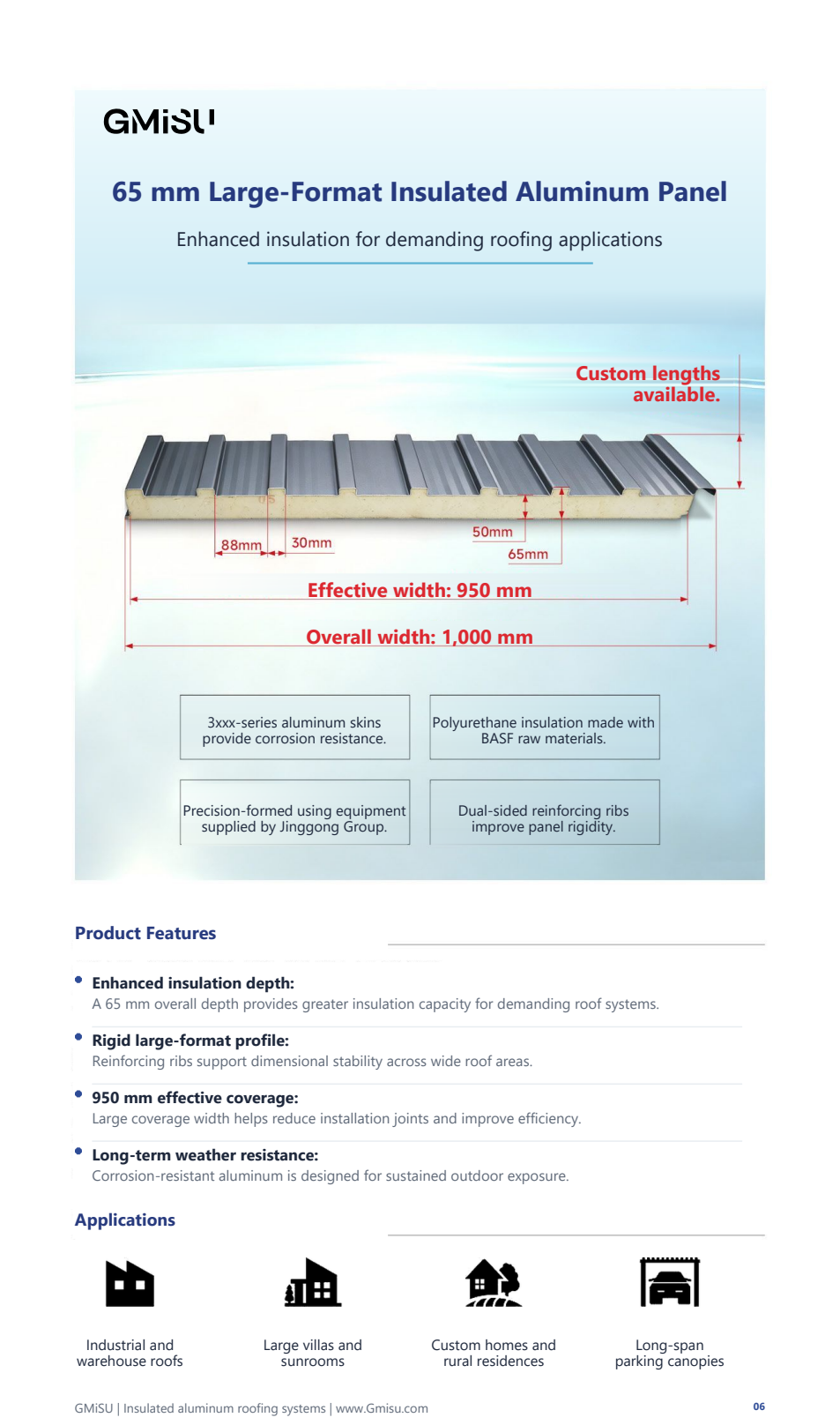
| 65 mm Large-Format Insulated Aluminum Panel | 65 mm | 0.32-0.35 W/(m2 K) |
How to read the values
A lower U-value indicates less heat transfer through the panel under the stated calculation conditions. Increasing polyurethane thickness therefore improves the panel's thermal resistance when the material system remains the same.
The 365 mm in the modular product name is its overall width, not its insulation thickness. Its U-value is calculated using the confirmed 35 mm panel thickness.
Whole-building energy performance also depends on joints, flashings, glazing, ventilation, roof geometry and installation quality. Panel U-value should be used as one input in the complete building design.
Confirm the right panel and specification with GMiSU.
Send your drawings, dimensions, quantity, color, destination and target schedule for project-based recommendations.